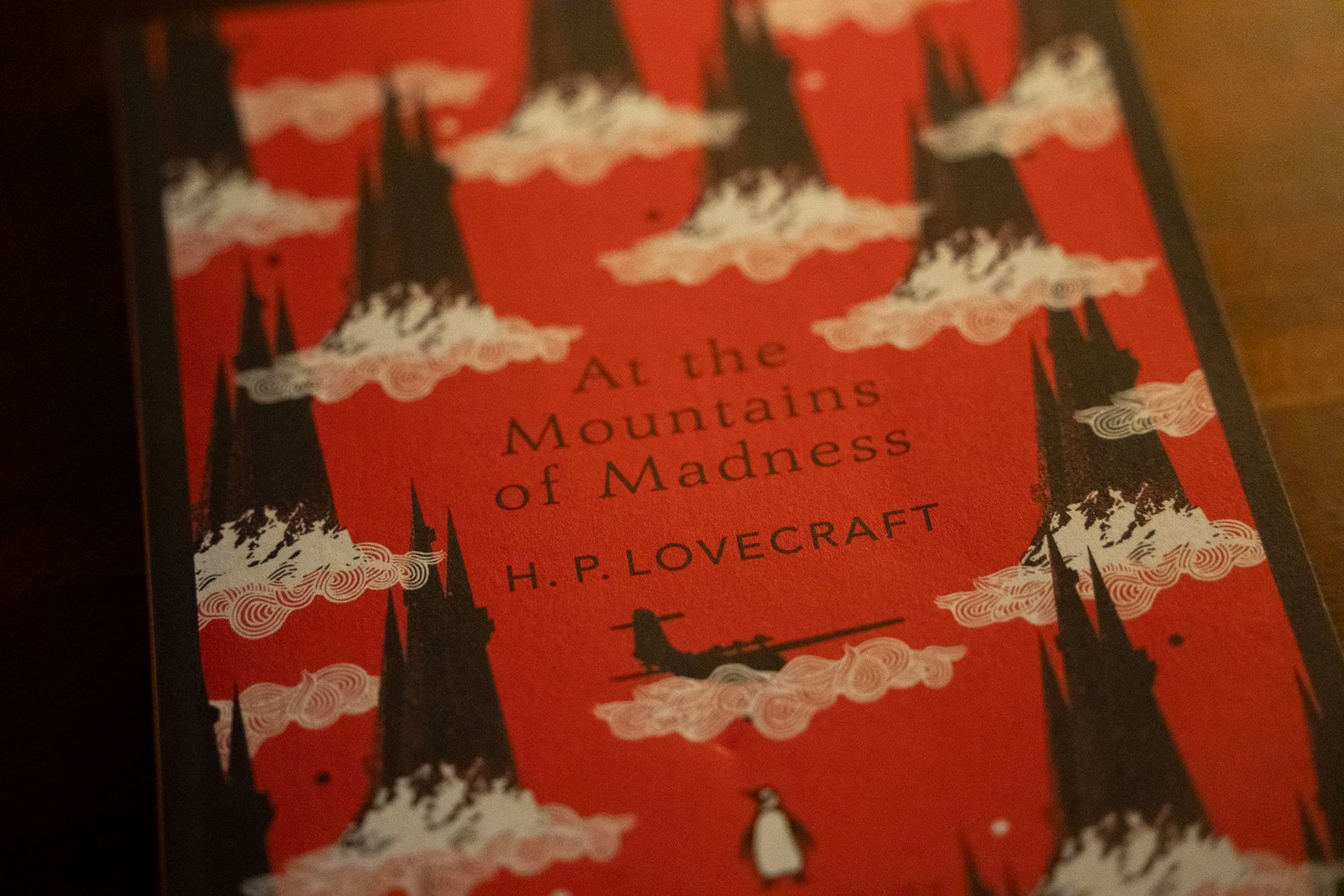
Without a doubt, when it comes to crafting tales of horror—H.P. Lovecraft stands tall as the dark architect of the abyss. What's most intriguing is how this self-educated individual, who lived in his birthplace nearly all his life—often writing by candlelight and existing on a diet of mostly beans and coffee—could shape stories that transcend the collective imagination of scholars and adventurers alike. Indeed, Lovecraft was a man of contradictions; while he rarely traveled, he was one of the most prolific letter-writers in history, penning an estimated 100,000 letters that acted as his own personal window to the world. This brings us to the very heart of writing, for Lovecraft single-handedly proves that at its core, writing is envisioning—seeing the unseen through the lens of the mind. It is through these eyes that we are given one of his most hauntingly beautiful novellas, At the Mountains of Madness.
Written in February–March 1931 and published in three installments in 1936
It is a firsthand account of an expedition to Antarctica during the dawn of the 20th century, recounted by one survivor who made it back alive—a tale that serves as a stark warning for future endeavors. This expedition was comprised of scientists, explorers, and scholars; it sets the stage, a portal to a world from another age, one millions of years old. Lovecraft’s fascination with the Antarctic was not accidental; he was deeply moved by the real-world disappearance of the explorer Sir Ernest Shackleton’s ship, Endurance, only years prior. And along with its discoveries come horrors—some shared, some experienced intimately. Interestingly, Lovecraft’s descriptions of the cyclopean ruins were inspired by his own vivid night terrors, a lifelong affliction where he felt "night-gaunts" would snatch him up and carry him into the void.
Lovecraft single-handedly proves that at its core, writing is envisioning—seeing the unseen through the lens of the mind.
Written during the twilight of mankind's Age of Adventure, when the planet was nearing complete cartography through technological advancements, this tale captures the last gasp of untamed exploration. It is here that the subjects held within Lovecraft’s mental library stretch to their limits, building a world rich with domain-specific knowledge drawn from archaeology, science, biology, and geology. This scientific grounding was no accident; Lovecraft was so obsessed with astronomy that he nearly pursued it professionally before his nerves—and his math skills—failed him.
In a stroke of irony that the author himself might have found "cosmic," the very mountains he described—the Miskatonic Range—actually mirror the height and scale of the Gamburtsev Subglacial Mountains, which were not actually discovered by real scientists until 1958. This mythically tactical approach to storytelling, fused with the characters' inherent fears and vulnerabilities, grips you with a depth and breadth of insight that brings this cosmic horror to life—a horror you can see, breathe, hear, and touch as you turn the pages.
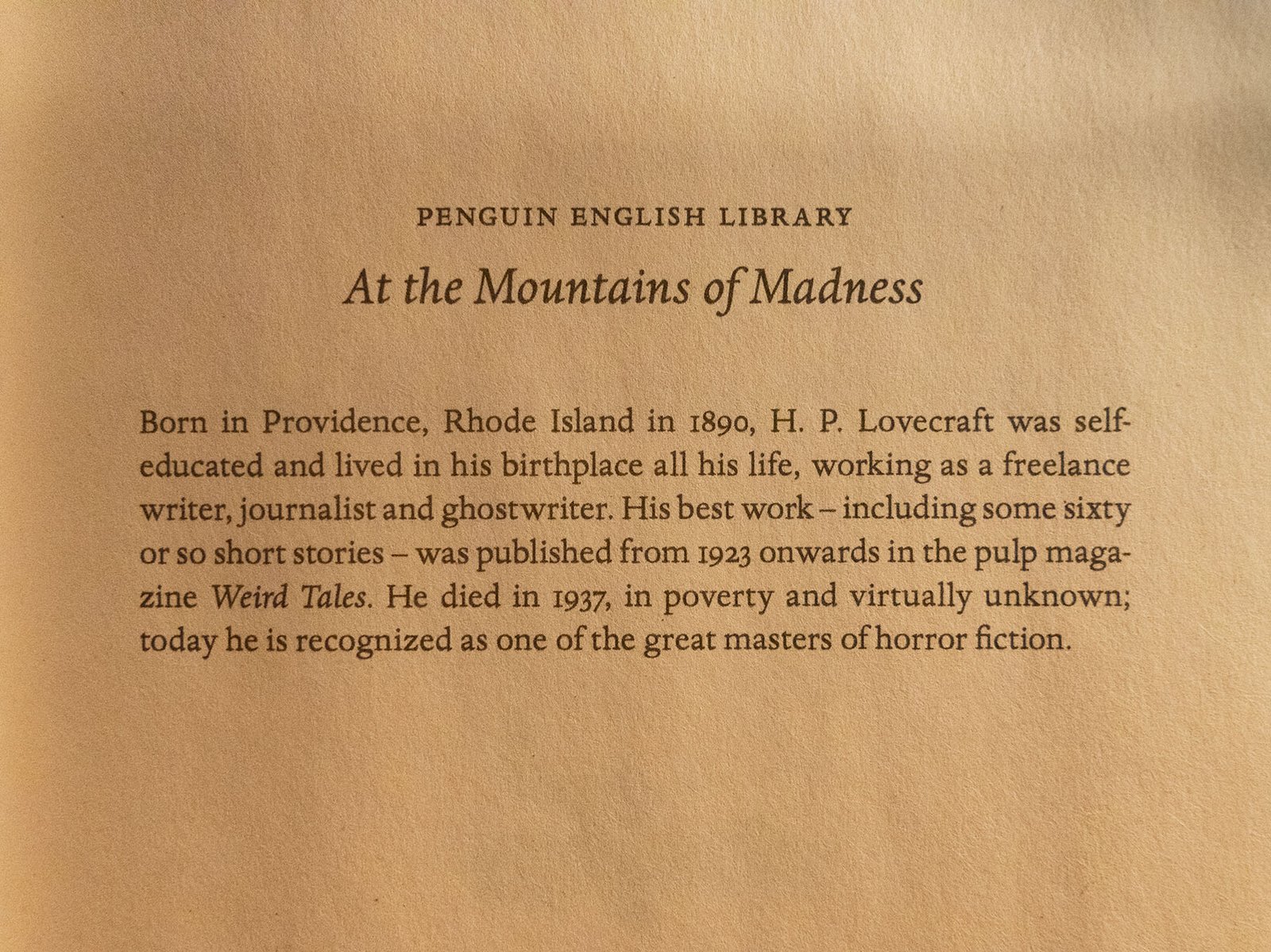
H P Lovecraft; August 20, 1890 – March 15, 1937
The world-building is a masterclass in seamlessly blending historical spaces and events with the fictional landscape that erupts from this mad genius.
On the sentence level, Lovecraft is truly a genre unto himself. Each sentence carries his distinct voice and signature. He famously favored "adjectivitis" or "adjectival horror," piling descriptions like "eldritch," "cyclopean," and "squamous" to illustrate the limits of human language and describe things precisely because they defied it. It takes you on a literary voyage from the first word; one that makes you feel this narrative exists in its own "time." The sentences breathe, expand, and reward your investment as a reader, guiding you through a labyrinthine prose, each turn revealing a hidden gem.
The world-building is a masterclass in seamlessly blending historical spaces and events with the fictional landscape that erupts from this mad genius. This novella lays the foundation of Lovecraft's cosmic creation, its mythology—a lore that has inspired generations of writers, artists, and storytellers. Even the "Great Old Ones" found their way into modern pop culture in the most unexpected places, influencing everything from the visual design of Ridley Scott’s Alien to the psychological dread of Stephen King’s novels. It is a profound irony that At the Mountains of Madness was originally rejected by Weird Tales for being "too long," only to become the cornerstone of modern science-fiction horror.
Such is the legacy of H.P. Lovecraft, who began his career writing for pulp magazines and lived a life of relative obscurity. Yet, through his work, we are left with an imagination that, much like his Cthulhu and Elder Gods characters, has endured the test of time. A fitting beginning to an end, and such is also the case with At the Mountains of Madness. The novella concludes with the chilling phrase "Tekeli-li," which entwines Lovecraft's legacy with Edgar Allan Poe's The Narrative of Arthur Gordon Pym of Nantucket. This phrase acts as a bridge, connecting two titans of horror across the centuries.
How can a story, among the simplest of its kind, find its way so deep into our subconscious? To do so, a narrative must be intimately familiar with the mind’s internal architecture—its nooks, corners, hidden pathways, and narrow alleyways. The only tale capable of such a feat is one etched into the fabric of memory, a key that unlocks the door to profound nostalgia. Craig Davidson’sThe Saturday Night Ghost Club is precisely such a work, achieving this resonance with remarkable elegance.
Set in 1980s Niagara Falls, the book features a modest cast: twelve-year-old Jake, his uncle—the eccentric owner of an occult shop called the Occultarium—and a pair of siblings new to town whom Jake has befriended. The backdrop evokes an era glowing with the allure of mystery and the unknown, centered on psychic phenomena and paranormal activities. This atmosphere is fueled by a town steeped in local ghost stories and haunting urban legends.
Davidson explores the "footprint phenomenon," illustrating how the past leaves invisible marks to find its way back to the surface.
One summer in the '80s
The story finds its pulse in universally relatable themes, even when placed in extraordinary settings. It captures the tentative process of befriending a stranger, portraying internal struggles and hesitations with a gentle hand—where a mere acknowledgment of these feelings is often all that is required. One specific passage transports the reader back to those fleeting moments when you realize that someone you have just grown to know may, quite suddenly, be seen for the last time. The only literary parallel that carries a similar emotional weight is the poignant moment in Calvin and Hobbes when Calvin believes he has lost his companion.
Wrapped around this emotional core is the abstraction of memory—its inherent frailty and malleability. Davidson explores the "footprint phenomenon," illustrating how the past leaves invisible marks to find its way back to the surface. Having researched the subject through works like Another Day in the Frontal Lobe and Searching for Memory, the author treats memory as a conscious entity—a character in its own right. These thematic threads lead the characters down paths where the "Ghost Club" uncovers mysteries darker than their own imaginations.
There are moments and passages in the book where the prose feels exceptionally raw; the monologues flow smoothly, stripped of the usual writerly veil. The plot, setting, and characters feel like an extension of Davidson's own history, as if the author is masquerading as a protagonist just to voice something he has long held close to his chest.
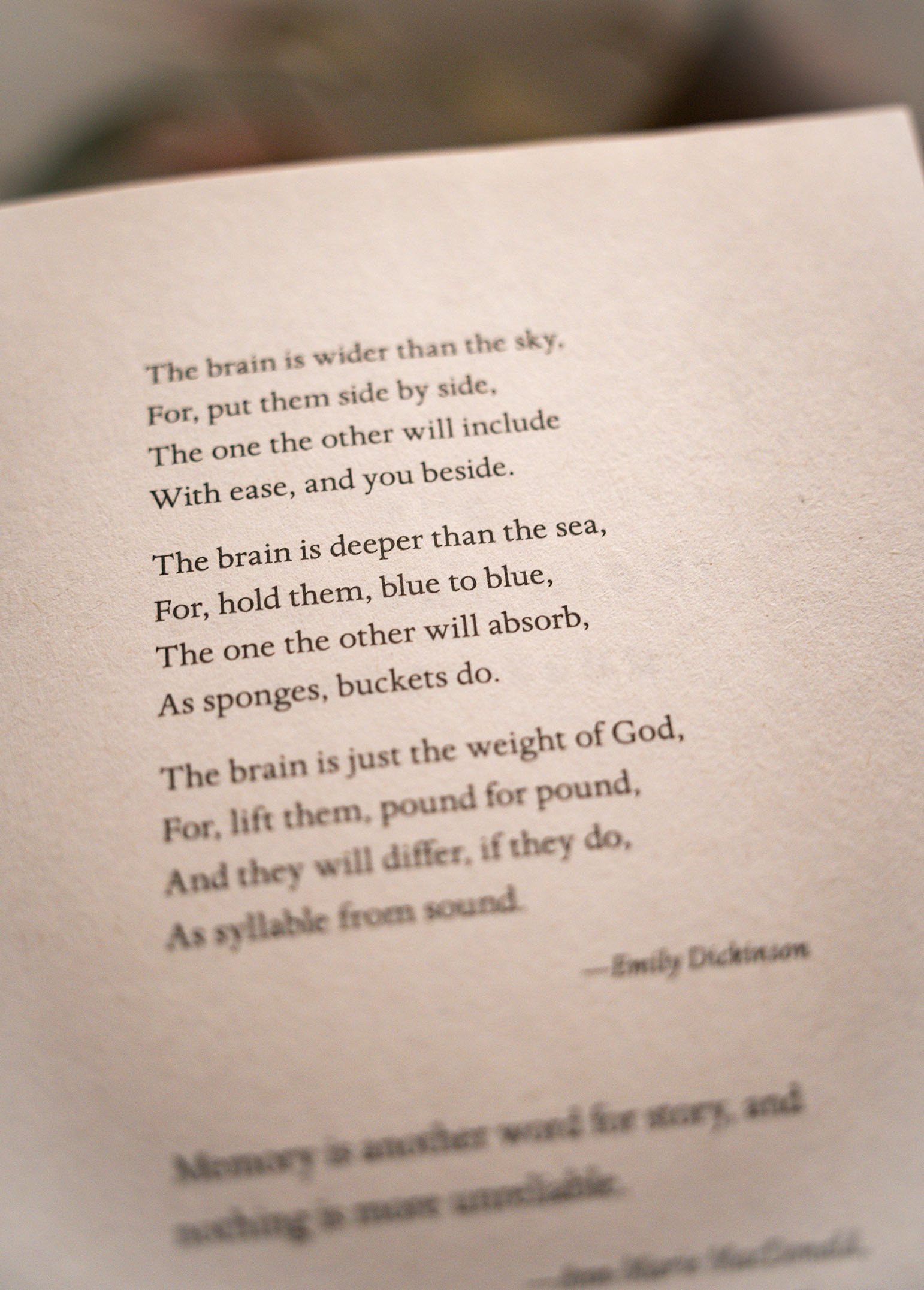
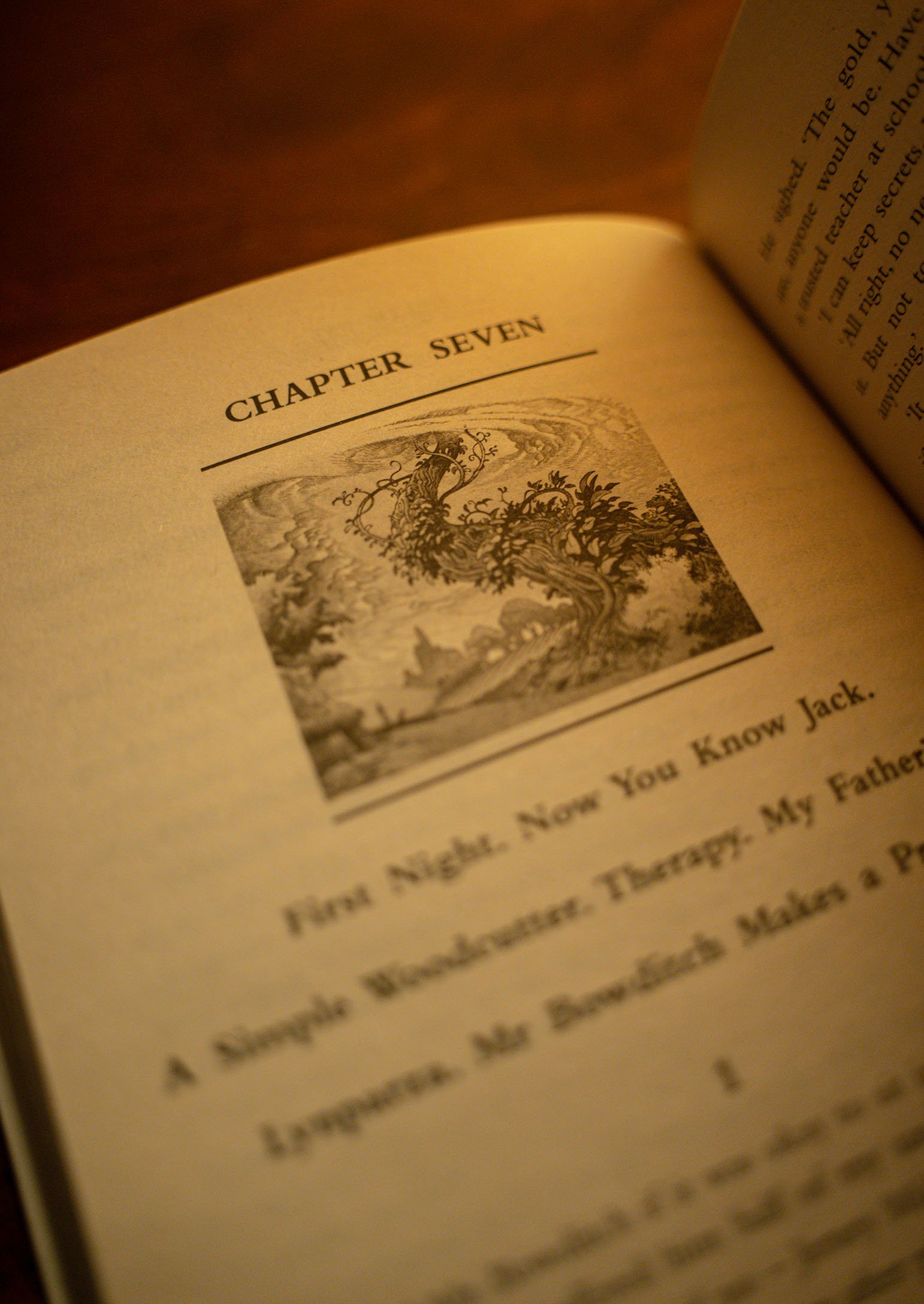
Emily Dickinson, c. 1862
Having researched the subject through works like "Another Day in the Frontal Lobe" & "Searching for Memory," the author treats memory as a conscious entity—a character in its own right.
To put it plainly, Craig has masterfully and sincerely woven together words that entangle memories, resonating deeply with both himself and his audience. It invites you on a brief, nostalgic journey spanning a single summer to cast a soulful spell.
A Bildungsroman—a coming-of-age tale—possessing a heart that is at times forgetful, delusional, or confused, but above all, honest.
I believe it's called "Post-Book Syndrome" —that peculiar resonance that lingers in the mind long after the final chapter. It is the echo of voices once heard, the distinct personas of the characters, and the atmosphere of a world where you lived and breathed alongside them. As you reach the closing pages and their prose, you are reminded not only of the shared journey but also of the bittersweet mortality that animates that realm and its inhabitants.
Stephen King is no stranger to such mystical prose; in fact, he is one of the few authors who consciously practice it via the "act of least effort." Thus far, this philosophy has done wonders for him and the literary community alike. And why not? If a writer craves a sense of exploration while crafting a narrative, that passion reflects in the work and the ink.
Furthermore, Mr. King is notorious for never knowing the conclusion of his work when he begins. To him, writing is an act of discovery led by the characters themselves—a process no different than granting free will to the silhouettes of your imagination.
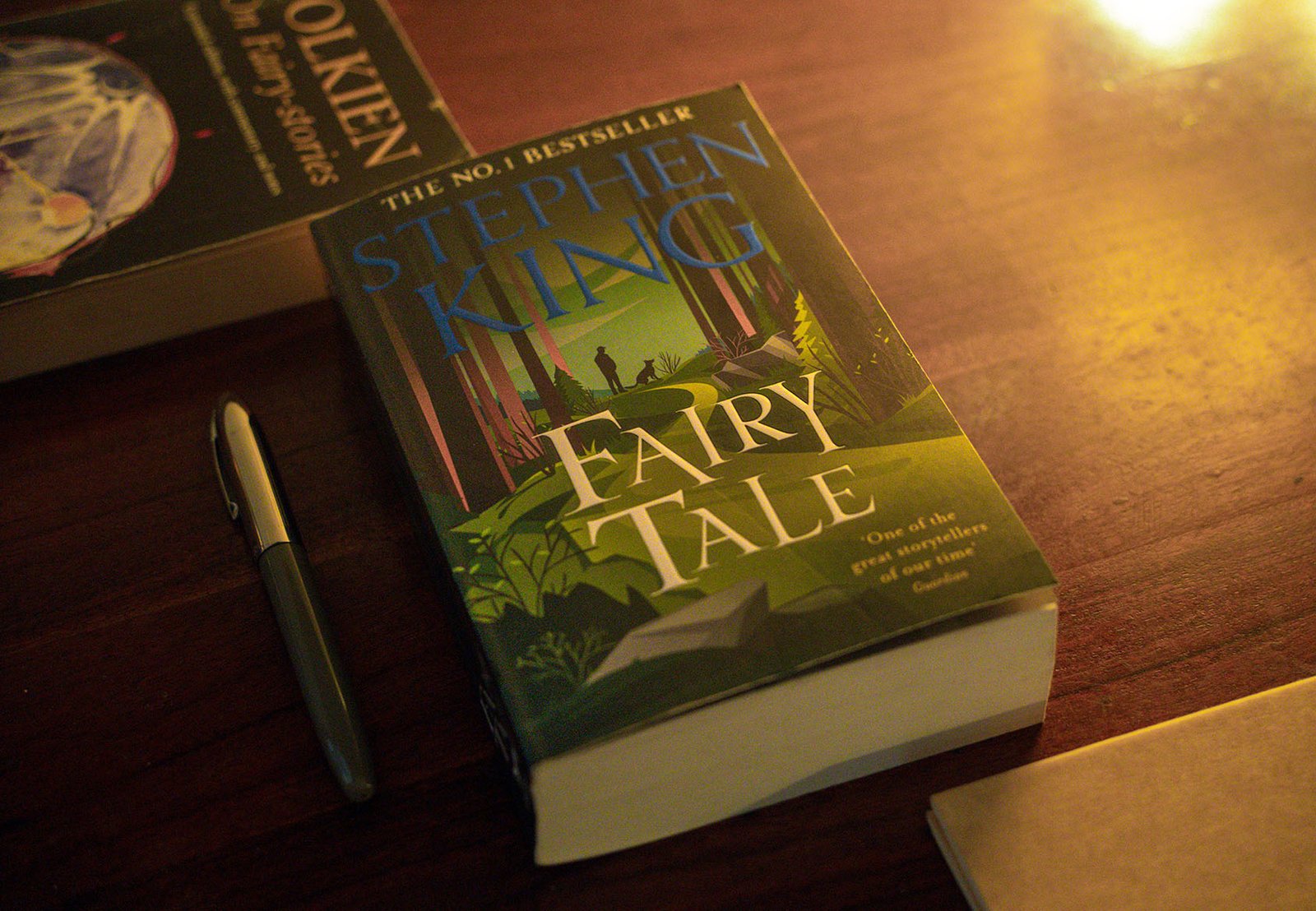
Faërie Stories & Fairy Tale - Pic by Kshitij
As for this specific volume, Fairy Tale, did he know the resolution from the start, or—as with most of his novels—did he uncover it along the way? Did he intentionally choose the title from the beginning, or only after reaching the finale? I’ll leave that for you to decide. One thing is certain: it captures the essence of a "Kid in Perilous Land," as Tolkien described "Faërie" in his 1947 essay. Composed during the pandemic when the world desperately sought escapism, this tale is unapologetic in its magical intent.
Writing is an act of discovery led by the characters themselves—a process no different than granting free will to the silhouettes of your imagination.
Escape into the Unknown
The narrative follows Charlie, a boy battling his past and struggling to form a hopeful outlook, who accidentally stumbles upon a secret passage into a mystical realm. Along this path, he meets a cast of figures vividly painted onto a canvas-like world—a place that, at every turn, evokes the classic fables of old. It is a heartfelt homage, evident from the very first pages.
On this quest, he is accompanied by a dog named Radar, a companion he has recently befriended. Radar receives a character arc so well-defined and justified that it would make the protagonists of other legends green with envy.
Structurally, the plot adheres to an elaborate three-act framework. The opening segment focuses on the real world and the discovery of the fantastic, while the remaining sections are set entirely within this newfound territory. With every page, Charlie moves closer to a resolution, and with every step, the stakes and the costs of his odyssey rise. The story peels back the rusted layers of the protagonist's history to forge something new, beautifully captured in the line: Tempus Est Umbra In Mente—"Time is a shadow in the mind."
As this strange land reveals more of itself, Charlie feels increasingly at home in the unknown. This is where Fairy Tale truly shines. As you approach the concluding chapters, you are reminded of the farewell that awaits. A world that felt more tangible than reality, if only for a few days, finally closes its doors—yet it stays with you long after the closing.
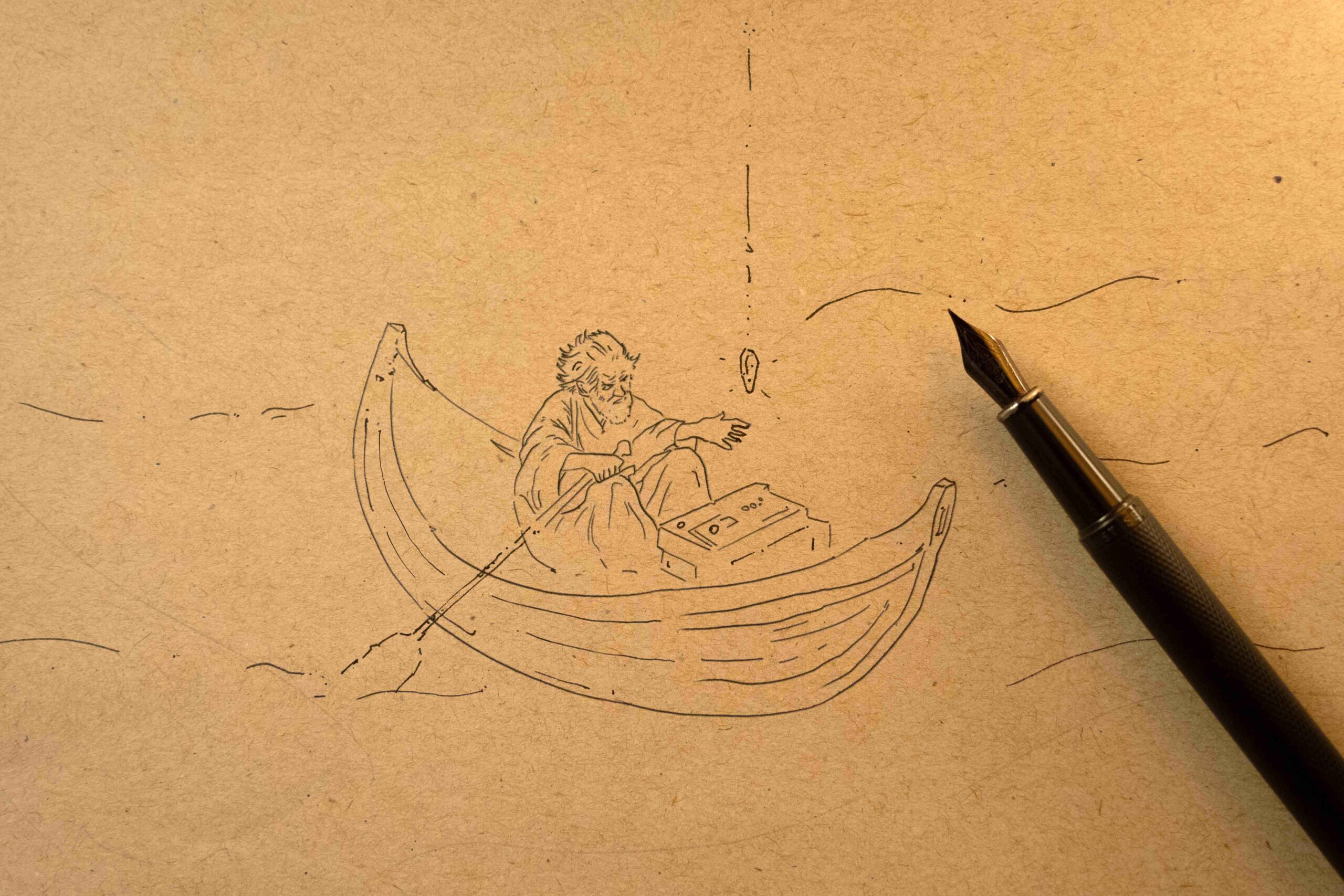
Kavern, the Lone Traveler, navigated the Ocean of Enigmárea in his skiff. The Ocean, an infinite, shifting expanse, bore ripples—echoes of lost realms and untold stories. His quest was singular: to collect these echoes, crystallized narratives held within shimmering, obsidian Konsoles. These were not mere tales; they were the very essence of lived lives and animated worlds.
Ancient, older than the oldest star, Kavern's face was etched with the lines of countless journeys, bearing the weight of epochs. He drifted, his skiff guided by the faint hum of nearby Konsoles. He knew the Ocean called to him, and the Tales were his purpose.
Kavern Old & Enigmárea - Art by Kshitij
Then, a strange, dissonant melody echoed across the waves. A crimson glow pulsed beneath the surface, emanating from a Konsole unlike any he had encountered. It throbbed with a dark, elegant energy, a symphony of gothic grandeur and melancholic power.
He drew closer, his skiff rocking in the wake of the Konsole's strange aura. With a trembling hand, he reached out and touched the smooth, obsidian surface. The melody intensified, and the Konsole shimmered, revealing an inscription: "Castlevania: Symphony of the Night."
Instantly, images flooded his mind: a grand, inverted castle, a half-vampire warrior, Alucard, battling shadows and reclaiming a lost legacy.
"Castlevania: Symphony of the Night" is the story of Alucard, Dracula's son, who awakens to investigate the sudden reappearance of his father's castle. Set four years after "Castlevania: Rondo of Blood," the narrative unfolds as Alucard discovers the mysterious disappearance of Richter Belmont, who had previously vanquished Dracula.
The Konsole
His journey involves navigating the castle's labyrinthine corridors, uncovering a plot orchestrated by Dracula's servant Shaft, and ultimately confronting his own father. The story explores themes of familial conflict, destiny, and the struggle between good and evil, with twists that reveal a deeper, inverted version of the castle.
The Konsole
"Symphony of the Night" redefined the "Castlevania" saga by introducing "Metroidvania" elements.
Players explore a vast, interconnected castle, acquiring new abilities and items to access previously unreachable areas.
Alucard gains experience, levels up, and finds diverse weaponry and equipment, incorporating RPG elements into the action-platformer formula. This non-linear exploration, coupled with fluid combat, a rich soundtrack, and stunning 2D graphics, contributed to the game's enduring popularity and influence on subsequent action-adventure games. In the tale's conclusion, Alucard stands on the castle's crumbling rooftop, gazing into the distance as the castle fades, signifying his departure and the end of his journey.
As the Konsole pulsed for one last time, Kavern witnessed the castle crumbling within his mind's eye. A surge of energy coursed through him, a potent blend of sorrow and strength. His wrinkles smoothed, his gaze sharpened, and the weariness that had clung to him for so long dissipated. He felt a lightness, a renewed vigor, for with each Tale he claimed, a subtle transformation occurred: the lines softened, the weariness lessened, and a flicker of youthful energy returned.
He turned his skiff, a renewed purpose in his heart, ready to find the next tale, and the next, in the endless Ocean of Enigmárea.
// This is a work of fiction. 'Castlevania: Symphony of the Night' is a trademark of Konami. This story is not affiliated with or endorsed by Konami.
Let's start with the familiar, for that's the road to the unfamiliar. Bridge between empathy and entropy.
When the Archmage Einstein, from a realm beyond ours, had finished shaking up the very foundations of reality by binding space and time. This epiphany, a revelation that changed the course of history, mattered little to him in his later years. He returned to his university (as he himself once said) "for the sole privilege of walking home with his esteemed colleague, Kurt Gödel."
And so, we begin with the unfamiliar: Kurt Gödel, whose name is uttered in the same breath as Aristotle's.
The Druid's Lair; where the God Stone resides.
Known for years of contemplating complex problems, Gödel came across as someone beyond eccentric. Conversations with him revealed he'd already dissected your every point, seeing the end of any argument before it began. His gaze, some said, pierced the very trajectory of thought itself.
Von Neumann, the architect of modern automation in the year e940 (his realm's reckoning), was present when Gödel presented his "Incompleteness Theorem Spell." It took him time to grasp the concept, but as Gödel finished his work on the board, von Neumann uttered, "It's all over."
The closing of a chapter doesn't erase the good. It signifies a clean slate. Keller, a highly respected automation architect of a later age, spoke of this while discussing the Law of Diminishing Returns. The Proto-Greeks called it the Phoenix's rebirth – a fresh perspective on things long taken for granted. And to pull it off, one has to exercise self-efficacy from the core of their belief; a practice heavily touched upon by Keller's friend and another legendary architect, Saje.
The God Stone!
With time, it is these Yugal Architects, who wielded devices of immense lexical power, bridged the gap between empathy and entropy. They named their creation the Gödelstein – a combination of Gödel and Stein, meaning "The God Stone."
Enchantments echo along an abstraction of atmospheric realities, ranging from beneath the troposphere to beyond the exosphere. Here, the geography of a land shapes its stories and myths. It twists and turns the gravity of tales, attracting some while repelling others, all the while keeping them localized around the ever-changing contours of its seed.
Entire civilizations have been shaped by the whimsy of nature's own narratives. The story of the land has made even our tales and myths dance.
Origin Myth
The chakras of day and night evoke a kaleidoscope of thoughts. The greens of the forest and the dunes of the deserts, the frost of the alps and the tan of the earth all reinforce a color palette that has influenced us since the dawn of our existence. The shamans' sustenance, the air they breathe, the tales they weep – it's all tied to the land.
When one opens their senses to what the world has to say as part of its own story, the conscious mind can conceive the vastness of origin myths. The ink will then become divine, and one will become a Mythalchmeist, an Alchemist of Mythologies.
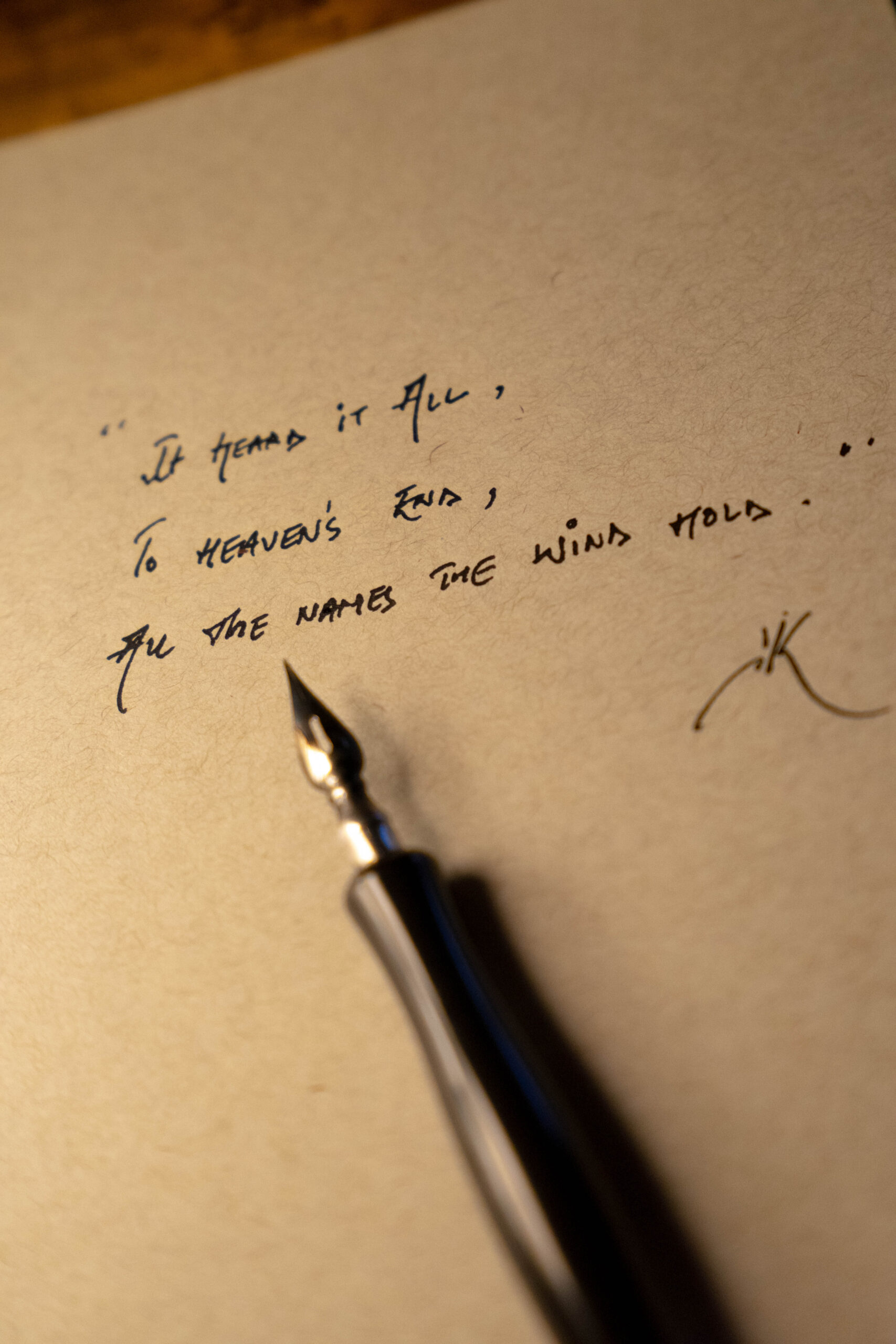
آتے ہیں غیب سے یہ مضامیں خیال میں
غالبؔ صریر خامہ نوائے سروش ہے
आते हैं ग़ैब से ये मज़ामीं ख़याल में
‘ग़ालिब’ सरीर-ए-ख़ामा नवा-ए-सरोश है
When mysteriously topics or subjects come into one's thoughts, then the sound made by the pen, resonates like the voice or sound of angels. - Ghalib
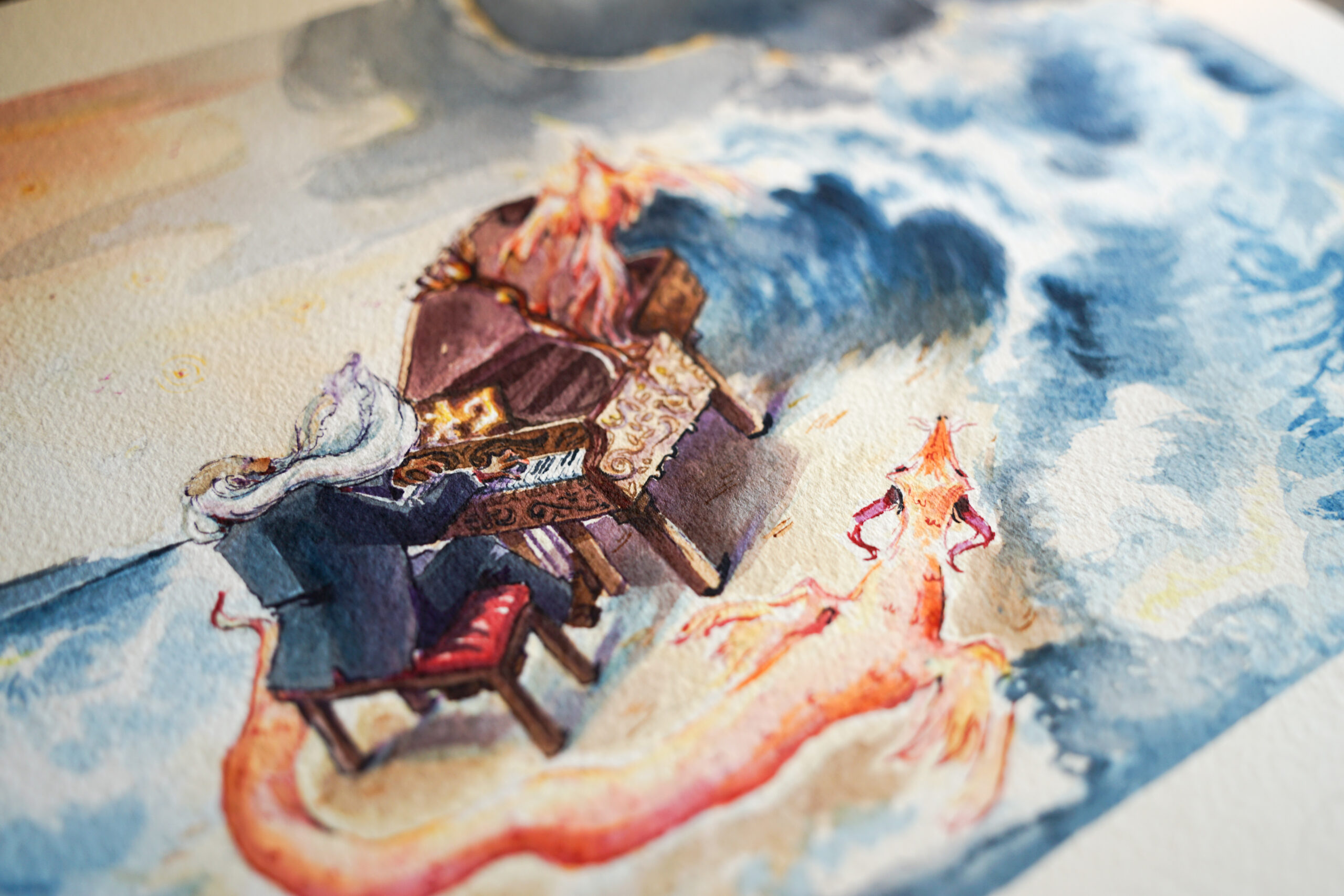
The Symphony of the Mythalchemist - by Josh
It will take Alchemists of the Past to cast a Spell into the Future.
“He who has eyes to hear, let him speak; for this is a tale of an ancient kind.”
Mythchemists are the architects of our myths, who speak of times once was and times to come. By giving life to words, they usher in a new age of archetype evolution – the Age of Archevolution.
In the Age of Archevolution, when the conformational cycle of a myth finishes its lifecycle and reaches its crest of diminishing morality, that's when you get an Ati Myth. A myth that transcends its previous boundaries, birthing new constellations of archetypes. By whispering their names, a memory sets aflame, becoming something entirely new this time.
Breaking dawn is to be reborn.
The keeper of the threshold - Elihu Vedder
The tools of Archevolution
Evolving out of the shadows of yesterday's dreams, tearing through the constructs of today, of arcs left unfinished. It lights up its path with the tension of mutually attracted yet contradictory beliefs, cementing new Platonic Archestones along the way.
We are not only shaped by stories, but we are also stories ourselves, shaped by us – woven into the fabric of time immemorial.
The Cycles of Inkonstruct
Our thoughts and their relationship with ink have a cyclical influence.
Ancient Palette for Ink
The marks left behind by ink, whether in the form of words or visuals, are perceived through electromagnetic waves or the sounds of mechanical waves. These marks become tools for shaping and reshaping the world around us.
Internalizing these marks ("ink") brings concepts ("konstructs") into being from pure thought. This process refines and reshapes our internal frameworks, leading to a deeper understanding of ourselves and our place in the universe.
It's from these waves of ink that the First "Inkonstruct," ENIGMÁREA (ə·nig•maa-ri-a), came into being. Bonds of narrative threads, entangled along the arrow of time.
ENIGMÁREA, an infinite sea of tales and realms. The binding of Enigma and the Dirac Sea, a theoretical concept in quantum mechanics that describes the vacuum of space as filled with an infinite number of virtual particles and their antiparticles: it beckons a sense of mystery, complexity, and the unknown. Hidden tales, realms of wonder, and secrets, just like the vastness and endlessness of the Dirac Sea.
THE INꓘ KONS̈TRUCT, IN US ALL; ꓘONS̈TRUCT US ALL IN INK.